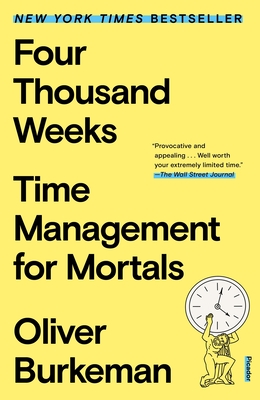
Four Thousand Weeks: Time Management for Mortals, by Oliver Burkeman
When I was a junior lawyer in the early 2000’s, a partner described me in a performance review as “very task oriented”. As someone who loves nothing more than ticking a completed task off a to-do list, I took this as a compliment. In hindsight, I’m not convinced he meant it as one.
This memory came back to me about halfway through Four Thousand Weeks, reading a passage on the “billable hour”, which Burkeman notes:
“obliges [lawyers] to treat their time, and thus really themselves, as a commodity to be sold off in sixty-minute chunks to clients. An hour not sold is automatically an hour wasted. So, when an outwardly successful hard-charging attorney fails to show up for a family dinner, or his child’s school play, it is not necessarily because he is “too busy” in the straightforward sense of having too much to do. It may also be because he’s no longer able to conceive of an activity that can’t be commodified as something worth doing at all.”
While (thankfully) things have not become that bleak for me, twenty-five years of dutifully recording every working hour does tend to instill a sense of time as a resource that can be harnessed, packaged up and sold. I’m hoping to get away from this mentality this summer, so Four Thousand Weeks seemed a good book to start on.
Burkeman’s basic premise, hence the title of the book, is that the average life spans only four thousand weeks which, in the scheme of cosmic time, is nothing. Counterintuitively, the book is not full of tips and techniques designed to squeeze every last minute out of this short span of time that makes up a life. Rather, Burkeman argues that the cultural pressure to relentlessly maximize our time is actually the root of the problem, and that only by embracing the hopelessness of this endeavor can we succeed in making the most of our time on earth.
The book feels quite rambling in places, jumping from more narrowly focused topics (how social media is sapping our ability to focus and our patience) to bigger picture points (how our obsession with maximizing every minute of the day negatively impacts our ability to connect with one another). Nonetheless, there is a theme to be found. This is that our finitude means that our lives are necessarily a never-ending series of choices, each once closing off a path that could have led to a different life. Burkeman argues that our distraction – starting new projects while leaving old ones unfinished, leaning on our phones and social media to divert our attention – stems from a subconscious desire to put off making these choices, for fear of closing off our ability to achieve the “perfect life”:
“In other words, it’s easy for me to fantasize about, say, a life spent achieving stellar professional success, while also excelling as a parent and partner, while also dedicating myself to training for marathons or lengthy meditation retreats or volunteering in my community – because so long as I’m only fantasizing, I get to imagine all of them unfolding simultaneously and flawlessly. As soon as I start trying to live any of those lives, though, I’ll be forced to make trade-offs – to put less time than I’d like into one of those domains, so as to make space for another – and to accept that nothing I do will go perfectly anyway, with the result that my actual life will inevitably prove disappointing by comparison with the fantasy.”
The cure for this, Burkeman argues, is acceptance. Once we accept that each choice we make closes off opportunities to do something else, and focus on making our choices consciously, and with a view to what’s important to us, happiness will follow. In his words, if our whole lives are borrowed time, “wouldn’t it make more sense to speak not of having to make such choices, but of getting to make them?”
The book shop sticker on the back of my copy of Four Thousand Weeks categorizes the book as “Self-Help / Philosophy”. Like the “Pilates/ballet mix” class Beth once made me go to that was definitely more ballet than Pilates, Burkeman’s book leans more philosophy than self-help. It is longer on questions that it is on answers, and offers surprisingly few tips (the Appendix, “Ten Tools for Embracing Your Finitude”, feels like a bit of an afterthought, even though it does pull together some of the book’s key points quite well). But that doesn’t detract from the book’s value as a well-researched and relatable thought-piece that enables self-reflection.
My friend’s father recently passed away, and he sent me his obituary. This told of a lawyer (no doubt familiar with recording billable hours on a timesheet) who had an impressive career as a litigator and then a judge, had raised a family whom he loved and who loved him, and had invested a substantial amount of time and energy in advocating for the rights and welfare of veterans. When I told my friend that I was impressed with the life his dad had made, he replied that his dad had described it as a “perfect life”. If, like me, you’d like to find out what that feels like, while Four Thousand Weeks probably won’t give you the answer, it’s a good place to start looking.
 James' Summer Reading
Leave a comment